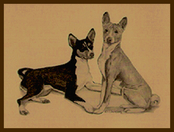
Basenji.
The Dogs of the Stone Age were small foxy fellows, who gathered around the first campfires. As ancient man went from place to place about his business, they followed at a respectful distance, probably attracted by occasional handouts, possibly because they felt an affinity to him. The first dogs, according to paleontologists, were very much like the Basenji, and there are scientific reasons for supposing that the Basenji was this dog of prehistoric times.
Living in long isolation from the outer world for countless thousands of years in the heart of Africa, the Basenji has not been altered by the demands and whims of man. Nothing about him has been changed - neither his size, his shape, the color and texture of his coat, nor his temperament. The Basenji is a well-defined natural breed and is one of Nature's Masterpieces.
The Basenji made an appearance in civilization at the dawn of history as a palace dog of the Pharaohs, so long ago that he watched the Pyramids being built. Pictured in bas-relief and sculptured in stone as far back as 4000 B.C., the Basenji even lent his ears to the dog-headed god Anubis. He was found in Mesopotamia many centuries later. The Metropolitan Museum of Arts owns a bronze statue of a man and his Basenji-like dog, including curled tail and wrinkled forehead. This is identified as Babylonian.
Ancient empires, crumbling, disappeared. So did the Basenji - and without a trace. The explorer Merolla, whom Edward C. Ash quotes in "Dogs and Their Development" caught a glimpse of him in the Congo in 1682. "These dogs, notwithstanding their wildness, do little or no damage to the inhabitants. They are red-haired, have small slender bodies and their tails turned upon their backs." Only as recently as the latter half of the 19th century were Basenjis re-discovered in their original habitat - the headwaters of both the Nile and the Congo, in the heart of Africa. There, they are the hunting dogs of native tribes, and so highly esteemed are they that they are regarded as having equal rights with their masters.
Author Unknown