Moving In Profile At The Trot
In the Royal Canadian Engineers, I had the opportunity to produce an animated training film. This animated film increased an appreciation for the way in which flip book art can be employed. I also remember flipping the corners of comic books as a kid, and the animated drawings I did on dog-eared textbooks.
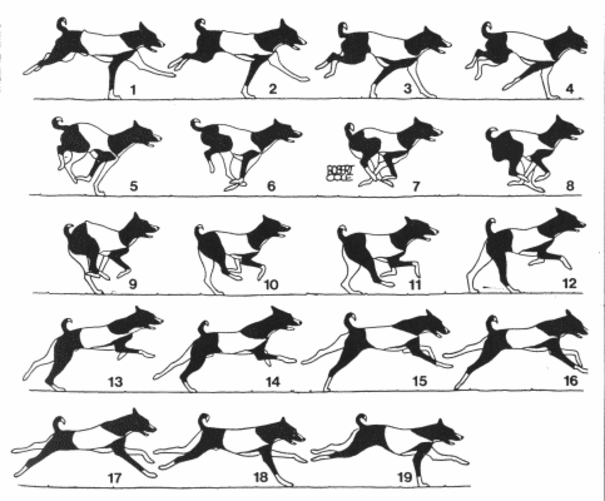
This (following) moving flip-art sequence has been traced from motion picture film footage of a real-life Basenji using the rotoscope method employed by film animators to transfer real action into realistic drawings.
. 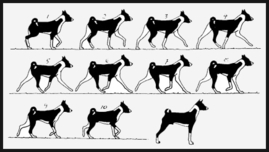
This sound real-life Basenji represents a typical, good moving example. (The) sequence was traced frame by frame from slow-motion film taken with a specialized motion picture camera.
It only requires ten drawings to depict the complete cycle, because, at the diagonal trot, one side of the dog is a mirror image of the other side. Each illustrated sequence begins with the right front foreleg in vertical support, a unique format that allows the action of individual dogs to be compared phase-by-phase.
Coming And Going Away
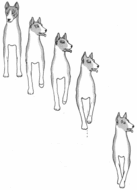
The Basenji Standard does not describe typical action coming and going away and, from time to time, the question arises as to whether or not the Basenji does or does not single-track.
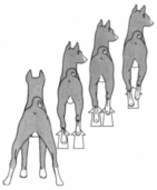
(Using the slow-motion camera techniques described above, it has been proven that) the Basenji does not single-track; few breeds do. Coming and going away, the Basenji's legs converge towards a center line under the body to minimize lateral displacement....the faster the trot, the greater the convergence.
The inner edge of the paw prints may even touch, but, in my opinion, it would not be to the Basenji's advantage for one foot to be carried around and strike the ground immediatley in front of the other front foot.
(While stacked and) viewed from behind, the column of bones from hip to pad should be straight. The hocks should neither turn out nor in. Moving, the hidlegs track directly behind those of the front, converging gradually towards the center of gravity as speed increases.
Double-Suspension Sighthound Gallop
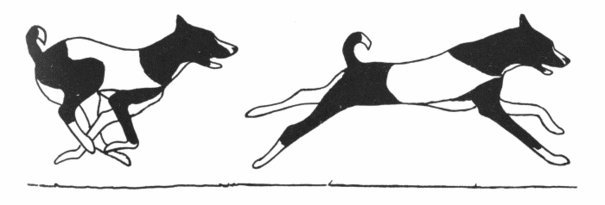
The Basenji is a dog with a proven ability to excel at the fast double-suspension gallop. It differs from the arched Greyhound, Whippet, Borzoi, etc. (as does the Afghan, Saluki, Pharoah Hound, and Ibizan), in that its back is level. The Basenji also differs (as does the Afghan Hound) in that, instead of slightly longer than high, the Basenji is as long as it is high. The Basenji shares with all Sighthounds: long legs, moderate angulation, light bones, flexible spine, a body that is not heavy, and a head that is not large; features which combine to produce excellence at the double suspension gallop.
Actions at this specialized fast gallop is so rapid and so complex that it cannot be analyzed by the eye unaided. The best aid is freeze-action photography. The best sequence photography is high-sopeed cine (motion picture) footage taken at Sighthound Firld trials, and traced frame by frame to produce a complete illustrated stride.
The double-suspension gallop employed by the Basenji is a rotary type, asymmetrical gait. The rotary type footfalls occur in a circe: RF then LF, then LH, and then RH......or the reverse. (Horses employ diagonal footfalls.)
A stride is a complete cycle at the gallop. Speed is the product of length of stride times the rate of stride. Speed can be increased by either lengthening the desirable portions of the stride, or increasing the frequency of the stride. Increasing leg length up to a certain point contributes to lengthening the stride, and therefore a Basenji's foreleg must always be longer than its body is deep. Flexing and flattening the spine at the gallop also lengthens the desirable portions of the stride, and therefore the Basenji's spine must always be flexible.
The desirable portions of the stride where lengthening increases speed are the phases where all four feet are free of contact with the ground. It is during these portions of free flight where the body is transported forward, and distance is covered. The faster the speed, the less number of feet there are on the ground at any given time, and the more periods of free flight.
http://www.basenjiclubofcanada.com/BCOC-BobCole.html#movproftrot